Black Friday 2026: Early data point to bargain-minded shoppers
October card data show more holiday transactions but smaller average tickets. Here is what that tells us, and what it cannot yet tell us, about Black Friday 2026.
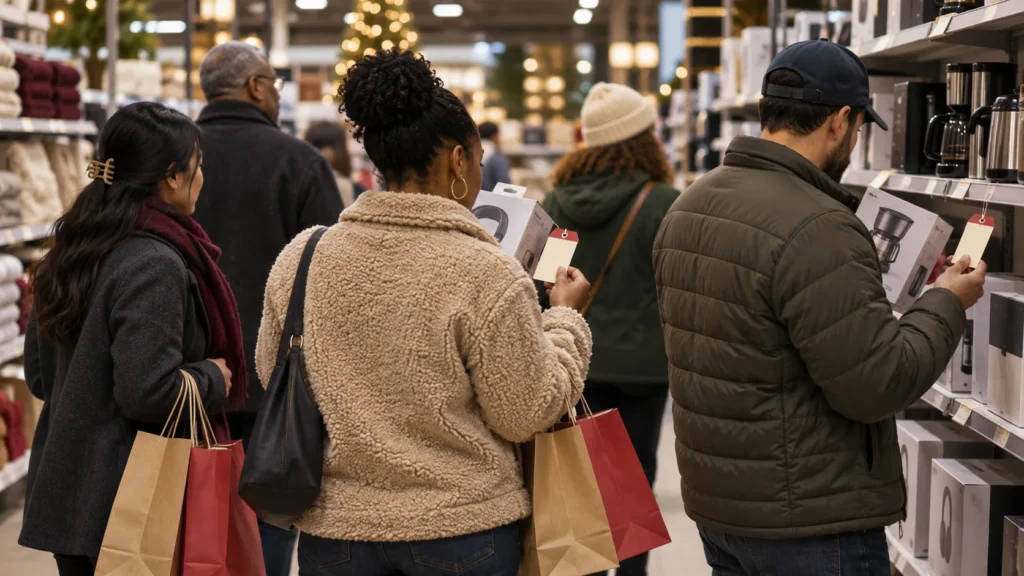
Nov. 27, 2026 — Black Friday shoppers are searching for bargains against a mixed consumer backdrop: early holiday purchases rose this fall, but the average amount spent per transaction fell in several shopping categories, according to Bank of America Institute card data. The figures describe activity before Friday’s sales, not the final outcome of Black Friday itself.
The institute’s November Consumer Checkpoint found that spending per household on selected holiday items was 7.3% higher in October than a year earlier. Transactions rose 9.3%, while the average amount per transaction fell 1.8%. That combination suggests more purchases at lower average ticket values in the bank’s data. It does not prove that every item became cheaper or that every U.S. household spent more.
What do the early holiday shopping numbers show?
Online holiday-item spending in Bank of America’s data grew 10.3% year over year in October. The number of online transactions rose 14.7%, while the average online transaction amount fell 3.8%. Clothing and general merchandise showed a similar pattern: more transactions alongside a lower average ticket. The report defines “holiday items” using merchant categories that normally derive at least 20% of annual spending in November and December.
These are internal card and deposit observations from one financial institution. They are useful for identifying patterns among its customers, but they are not an official census of all U.S. purchases. A smaller average ticket can reflect different products, different basket sizes or discounts; the figures alone cannot isolate which explanation dominated.
Why are bargains central to Black Friday 2026?
The National Retail Federation’s holiday survey found that 56% of respondents said the state of the economy would affect their spending plans this year. In another survey released before Thanksgiving, NRF estimated that 182.7 million people planned to shop over the five-day holiday weekend, including 126 million on Black Friday. Those are survey-based intentions, not a count of people who have already shopped.
The contrast helps explain this year’s shopping story: demand can remain strong even when consumers are careful about how much they pay for each purchase. Retailers may attract visits with promotions, but an early burst of transactions does not automatically translate into the same growth in dollars or profits.
Does the data tell us how Friday’s sales will finish?
No. Bank of America’s October figures were published on Nov. 12, before Black Friday. NRF’s figures measure plans made ahead of the weekend. Neither source reports a final Nov. 27 sales total. Friday’s actual online and in-store results will require transaction data after the day ends, and different research firms may use different coverage and methods.
Consumers comparing advertised discounts should check the final price, shipping charges and return terms. For the broader economy, the useful question is whether the early pattern of higher transaction counts and lower average tickets continues through the full holiday season. New daily sales estimates can provide a first look, but the final picture will take longer to develop.
Sources
How did this story land?
Choose one reaction
Tap again to remove your reaction.
Comments 0
Join the discussion with a thoughtful take.
Start the conversation.