Cygnus XL Launches With 11,000 Pounds for the ISS: What Happens Next?
NASA confirms Sunday's Cygnus XL launch from Florida. The spacecraft is carrying about 11,000 pounds to the ISS, with capture planned for Tuesday.
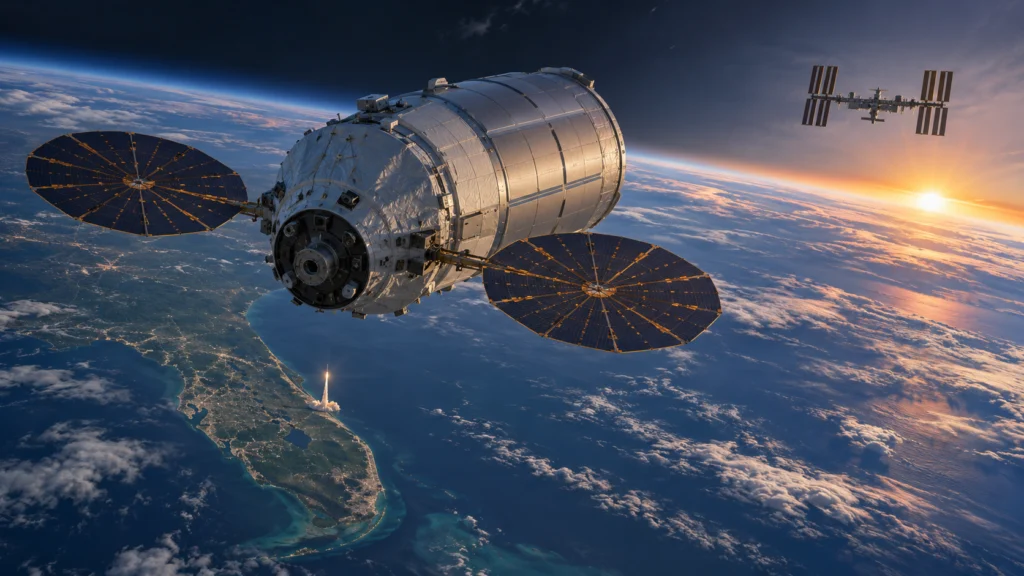
A cargo spacecraft carrying about 11,000 pounds of supplies and research launched toward the International Space Station from Florida on Sunday. NASA says Northrop Grumman’s Cygnus XL lifted off at 10:47 a.m. EST aboard a SpaceX Falcon 9. The next test is the journey to the station: launch is confirmed, but arrival and unloading are still ahead.
What happened at Cape Canaveral?
The Falcon 9 departed Space Launch Complex 40 at Cape Canaveral Space Force Station on November 29, NASA reported. Its passenger is the larger Cygnus XL cargo ship on Northrop Grumman’s 25th commercial resupply mission for the agency. The payload includes food and equipment for the crew alongside experiments that need the unusual conditions of orbit.
A rocket leaving the pad is only the opening move. NASA’s launch update said Cygnus was expected to reach a preliminary orbit roughly 10 minutes after liftoff and deploy its solar arrays later. The agency’s update confirmed the launch; it did not report that the spacecraft had already arrived at the station. Readers following the mission should distinguish that milestone from the planned capture and installation.
When will the station receive the cargo?
NASA plans to begin live arrival coverage at 1:10 a.m. EST on Tuesday, December 1. Astronauts Jessica Watkins and Luke Delaney are scheduled to use the station’s Canadarm2 robotic arm to capture Cygnus at about 2:35 a.m. EST. Ground controllers will then install the spacecraft at the Unity module’s Earth-facing port, where the crew can unload it. Those times are the current plan, not completed events.
The sequence matters because Cygnus is not a vehicle that astronauts simply dock by opening a hatch on arrival. First it must approach safely, be grappled by the arm and be berthed to the station. NASA says it will cover the arrival live, while the installation itself will not have live coverage.
What is aboard?
The cargo is more than a restock. NASA’s mission overview describes studies that could eventually inform health care on Earth and future long missions. One, called Cardinal Muscle 2.0, uses human muscle tissue models to test whether drugs already approved for other uses might help limit muscle loss. Astronauts experience muscle loss quickly without exercise in microgravity, giving researchers a way to study a problem that also affects older adults.
Another experiment, DNA NANO B, investigates how tiny DNA-inspired particles can be assembled in microgravity. Researchers hope to learn whether that process could improve delivery of medicine into dense tissues such as cartilage or solid tumors. That is a research goal, not a treatment ready for patients. The Active Radiation Environment Sensor will test equipment intended to monitor radiation inside future spacecraft, a practical concern for crews traveling beyond the station.
NASA says this is the third flight of Cygnus XL, which can carry more cargo than the earlier version. The spacecraft is named for astronaut Jim Lovell, whose missions included Apollo 8 and Apollo 13. The name links a routine-looking supply run to a longer history of U.S. spaceflight, but the work on this flight is immediate: get the experiments and daily essentials safely into the crew’s hands.
The next firm update to watch is NASA’s confirmation of Cygnus reaching the station and being captured on Tuesday. Until then, Sunday’s confirmed news is the successful departure from Florida with roughly 11,000 pounds bound for orbit.
Sources
How did this story land?
Choose one reaction
Tap again to remove your reaction.
Comments 0
Join the discussion with a thoughtful take.
Start the conversation.